


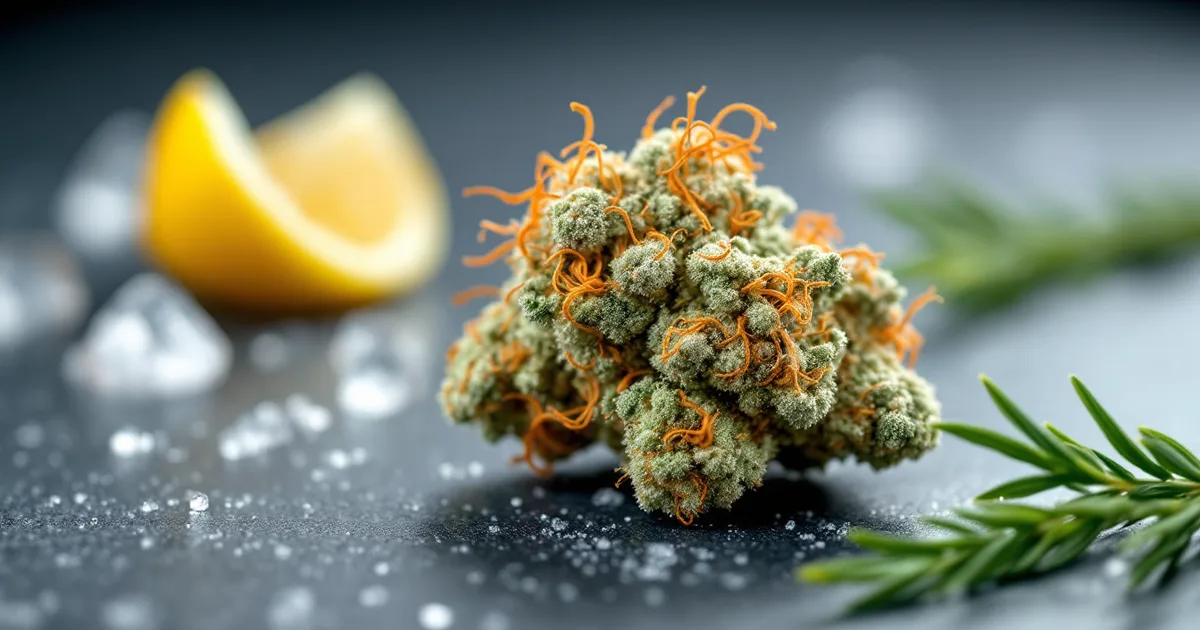

Around four in five cannabis strains lead with myrcene, caryophyllene or limonene, going by the dominant-terpene breakdown that SC Labs publishes. Terpinolene leads in roughly one in ten. The Trainwreck strain belongs to that smaller group, and it is one of five strains SC Labs names as commonly terpinolene-dominant.
That single fact explains a lot about Trainwreck weed. The sharp pine, the sweet lemon and the herbal, slightly floral edge all trace back to a terpene most strains carry only in small amounts. This guide sticks to what can be checked. So: the strain's origins, a peer-reviewed look at its terpenes, what users say it does, and how we rebuild the profile at Entour™.
Trainwreck at a glance
| Trait | Trainwreck |
|---|---|
| Type | Hybrid, usually described as sativa-dominant |
| Origin | Arcata, Humboldt County, Northern California |
| Reported lineage | Mexican sativa × Thai sativa × Afghani indica |
| Dominant terpene | Terpinolene |
| Supporting terpenes | Myrcene, limonene, ocimene, pinene, β-caryophyllene (order varies by source) |
| Aroma | Pine and lemon, with an herbal, earthy finish |
| Reported effects | Euphoric, uplifted, creative |
| THC | 17% on Leafly, 21.74% listed for Green House Seed Co.'s seed line |
| Entour™ blends | Trainwreck Native®, Trainwreck Live Derived®, Tropical Trainwreck™ (Inspired®) |
What is the Trainwreck strain?
Trainwreck is a Northern California hybrid bred from Mexican and Thai sativas crossed with Afghani indica genetics. Leafly's Trainwreck entry gives that cross and calls the result a "Northern California staple."
The seed company Green House Seed Co. narrows the location down. Its product page calls Trainwreck "the legendary clone-only strain from Arcata, California." It describes the genetics as "a cross of a Thai, a Mexican and an Afghani plant." Arcata is in Humboldt County, which is why our own product notes give Humboldt as the strain's home.
Clone-only, then seed
Clone-only means the original plant spread as cuttings passed from grower to grower, not as seeds. Seed versions, Green House's among them, came later. A jar labeled Trainwreck today could hold a descendant of the old cutting or a seed-grown plant. The two will not always smell the same.
Green House also describes how the parents show up in the plant. It points to sativa-style "big foxtails" and vine-like growth, with "the compactness of the Afghani strain" making it a strong yielder.
When it took off, and where the name came from
Sources disagree on timing. Green House says the cut became very popular at the beginning of the 1980s. Our own product notes date its rise to the late 1990s. We have not found a primary record that settles it.
Several stories circulate about the original growers and the name, and we could not document any of them. Leafly's description offers the plainest reading: effects that "hit like a freight train."
What does Trainwreck smell like?
Trainwreck smells like pine and lemon first, with an herbal, earthy finish. Leafly sums up the aroma as "sweet lemon and spicy pine" and lists pine, earthy and woody as its top flavors. Green House describes "fresh lemony-citrusy notes with a hint of menthol and some earthy background on the exhale."
The hardest note to name is the terpinolene. SC Labs describes its nose as "woody and herbaceous yet floral." It also lists lilac, tea tree, apples, cumin and nutmeg as places terpinolene occurs in nature. That green, resinous freshness is what sets Trainwreck apart from limonene-led dessert strains like Wedding Cake. Our terpinolene terpene guide covers the compound in more depth.
Trainwreck terpene profile: what the lab data shows
Terpinolene is Trainwreck's dominant terpene, and published lab data backs that up. In 2017, Justin Fischedick published an analysis of 233 cannabis samples from 30 cultivars in the journal Cannabis and Cannabinoid Research. The samples came from one California medical dispensary over the course of a year. Terpenes were measured by gas chromatography with flame ionization detection, with peaks confirmed by GC-MS.
Seven of those samples were Trainwreck. These were their average levels for the main Trainwreck strain terpenes:
| Terpene | Average, mg per gram |
|---|---|
| Terpinolene | 9.6 |
| Myrcene | 3.7 |
| Limonene | 3.4 |
| trans-Ocimene | 2.6 |
| β-Pinene | 1.5 |
| β-Caryophyllene | 1.5 |
| α-Pinene | 0.9 |
Source: Fischedick (2017), quantitative terpenoid table, Trainwreck column, 7 samples.
Terpinolene came in at more than twice the level of myrcene, the next terpene down. The study grouped Trainwreck with Jack Herer as terpinolene-dominant, and the gap between the two is telling. In the paper's words, "Jack Herer mainly differed from Trainwreck due to lower levels of myrcene and limonene."
That makes Trainwreck terpinolene with a fuller supporting layer. SC Labs notes that limonene is common to lemon and other citrus oils, which lines up with the lemon people describe. Myrcene, which SC Labs calls "earthy and herbal," fits the earthy finish. Our Jack Herer terpene profile covers the other half of that pairing.
Reading the numbers with care
Treat those averages as a snapshot, not a spec. The data is from 2017, from a single dispensary, and from only seven samples. The spread was wide too: terpinolene was reported as 9.6 ± 4.8 mg/g, so individual samples varied a lot.
Other sources order the supporting terpenes differently. Leafly lists terpinolene, myrcene and pinene. Our product pages list terpinolene, β-caryophyllene and myrcene. The sources we cite agree on the lead, and the order underneath moves with the cut, the grow and the lab. Fischedick's abstract makes the wider point that cultivar names are a weak guide to chemistry: they are applied using "obscure and inconsistent nomenclature."
SC Labs puts Trainwreck in the same terpinolene camp as Jack, Classic Haze and Super Lemon Haze.
Trainwreck strain effects people report
Users most often describe Trainwreck as euphoric, uplifted and creative. Those are its top three reported effects on Leafly, whose description mentions "a surge of euphoria, awakening creativity and happiness." The most common negatives listed there are dizziness, dry mouth and dry eyes.
Green House gives a two-stage account: "stimulant and creative at first," then more intense after a few minutes, and "very long-lasting." It describes a sativa-style head effect alongside a heavy indica body feel.
Terpenes do not cause intoxication on their own. That comes from cannabinoids such as THC, a split we explain in terpenes vs. THC. What terpenes do is shape the aroma and color how an experience gets described. Terpinolene-led strains as a group carry an upbeat, creative reputation, and Trainwreck is a textbook case.
Who Trainwreck suits
Trainwreck tends to suit people who like a pine-and-lemon profile and the uplifted, creative effects users report. If your favorite strains are heavy and sedating, the descriptions above put Trainwreck at the other end of the spectrum.
For brands, the case comes down to three things:
- It stands out on a menu. Terpinolene leads in only about one strain in ten in SC Labs' data. A Trainwreck SKU smells different from the myrcene and limonene profiles around it.
- The name carries history. A clone traced to Arcata, with decades of reputation behind it, is a name longtime consumers already know.
- It anchors a terpinolene lineup. Shelved next to Jack Herer and Super Lemon Haze, it gives customers who like one of them a clear next pick.
The risk is a flat recreation. If a Trainwreck product smells like generic pine and citrus, check where terpinolene sits on its COA. When it is not clearly in first place, the strain's signature is missing.
How Entour™ recreates Trainwreck
We build each of our Trainwreck blends with True To Plant®, our process for fingerprinting a cultivar at high resolution. The profile is then rebuilt from natural, non-cannabis ingredients, so there is no flower and no THC in the bottle. All three product pages list the same lead terpenes in the same order: terpinolene, β-caryophyllene and myrcene.
Those pages give terpene order, not percentages. Read the 2017 averages above as a description of the strain, not a spec sheet for our blends.
Trainwreck Native®
Native® is the line we use for faithful, cultivar-specific reads. Trainwreck Native® is the straight read on the strain. Its tasting notes run through pine, neem, nettle, sage and oregano, with dried citrus rinds, cumin and cardamom also in the mix. The page sums up the vibe as "climbing a pine tree limb-over-limb."
Trainwreck Live Derived®
Live Derived® is our premium tier, built to capture more of a cultivar's character. Trainwreck Live Derived® keeps the pine, herb and citrus-rind structure and adds herbal, earthy undertones. Its page calls it a "pine pour over." Despite the name, it is still botanical, not cannabis-derived.
From 30 mL up, it costs exactly $1.00 more per milliliter than Native® at every size. A 120 mL bottle, for example, is $570 instead of $450. Whether that premium pays off comes down to whether your customers can tell. Our guide to when Live Derived® terpenes are worth the cost works through that question.
Tropical Trainwreck™
Our Inspired® line covers "Flavor-forward cultivar-specific Native® profiles," and Tropical Trainwreck™ is the fruit-first take on this strain. The product page describes it as a Flavor Lab cross between the original Trainwreck and an equatorial plantation. Pineapple, lime-gassed mango, pink peppers and candied papaya lead the palate. Tropical Trainwreck™ fits products where tropical fruit is the selling point and Trainwreck is the backbone.
FAQ
Is Trainwreck indica or sativa?
Trainwreck is a hybrid that most sources describe as sativa-dominant. Leafly classes it as a hybrid while describing a potent sativa, and our product notes call it sativa-dominant. Green House Seed Co. is the outlier, listing its seed version as 40% sativa and 60% indica. On the chemistry side, Fischedick noted that Trainwreck and Jack Herer bear a strong resemblance to "other accessions described as sativa dominant."
What terpenes are in Trainwreck?
Terpinolene leads. In Fischedick's 2017 dispensary data, the next terpenes were myrcene, limonene and trans-ocimene, followed by β-pinene and β-caryophyllene. Leafly lists myrcene and pinene behind terpinolene, and our blends list β-caryophyllene and myrcene. The supporting order varies with the cut and the lab.
What does Trainwreck smell like?
Pine and lemon up front, with an herbal, slightly floral edge and an earthy finish. Green House adds a hint of menthol to that description. The herbal, floral note comes from terpinolene, which SC Labs describes as "woody and herbaceous yet floral."
How strong is Trainwreck?
Leafly lists Trainwreck at 17% THC, and Green House Seed Co. lists 21.74% THC for its seed line. Actual potency depends on the plant, the grow and the batch, so the product label is the number that counts. Our Trainwreck terpene blends contain no THC.
Why is it called Trainwreck?
We could not find a documented answer. Several stories about the original growers circulate, and none come with records we could check. Leafly's description offers the simplest explanation: effects that "hit like a freight train."
Where to take this next
Find your strain profile: Trainwreck Native® is the closest read on the strain, starting at $35 for a 5 mL bottle. If you are building a product line around Trainwreck and need bulk pricing or a custom match, contact our formulation team.
About the author: The Entour™ team is a division of The Werc Shop®, the first commercial cannabis laboratory to test for terpenes back in 2011. The team formulates True To Plant® terpene profiles for licensed cannabis brands across the US, Canada, and tribal markets.
Read More

Citrus Sunrise Strain: Effects, Flavors, and Why It's Worth Trying
If you're on the hunt for a strain that wakes you up without wiring you out, the Citrus Sunrise strain deserves a serious look. This sativa-dominant hybrid punches above its weight with a vibrant citrus aroma, clean-headed effects, and a flavor profile that actually lives up to its name. Here's everything you need to know.

Blueberry Bubba Strain vs. Other Indica Hybrids: What Makes It Stand Out
The indica hybrid category is crowded. There are dozens of strains competing for attention, all promising relaxation, stress relief, and sleep support. So what makes Blueberry Bubba stand out in a crowded field? The answer comes down to three things: lineage, flavor, and effect consistency. If you're already familiar with the basics, the full Blueberry [...]

Blueberry Bubba Strain: Flavor, Effects, and Everything You Need to Know
Some strains earn their name honestly. Blueberry Bubba is one of them. A cross between Blueberry and Bubba Kush, this indica-dominant hybrid delivers exactly what those parent names suggest: rich berry flavor, deep relaxation, and an effect profile that's become a go-to for evening use. Here's a complete breakdown.