


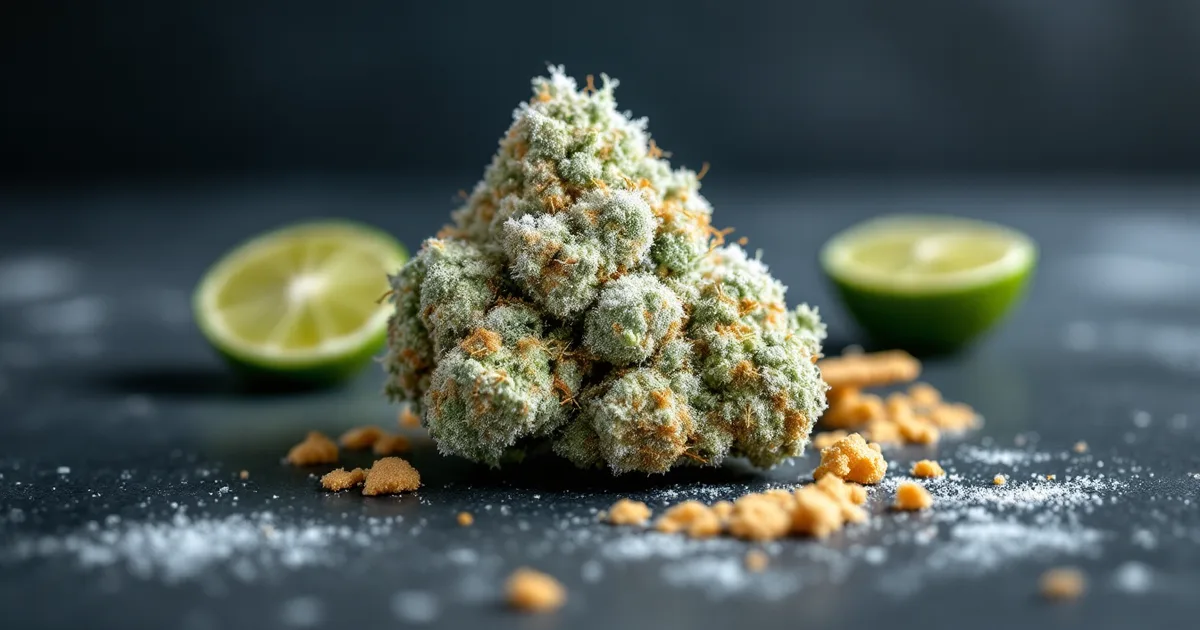

The best-documented version of the Key Lime Pie strain started as a single clone passed between growers in Santa Cruz, California: a resinous cut of GSC that smelled of sour lime instead of cookie dough. It stayed clone-only until a California seed company crossed it back into GSC and released it as seed.
The name promises citrus. The published lab data says spice comes first. That gap is the most useful thing to understand about Key Lime Pie, for anyone choosing flower and for any brand trying to put the flavor in a product.
Key Lime Pie at a glance
| Trait | Key Lime Pie |
|---|---|
| Type | Hybrid on Leafly and Weedmaps; "mostly indica" on SeedFinder's Purple Caper listing |
| Lineage | Phenotype of GSC; the Purple Caper seed line crosses that cut with a GSC F2 male |
| Origin | California, with two reported sources: Purple Caper Seeds (a Santa Cruz cut) and Burning Bush Nurseries |
| Also sold as | Key Lime Cookies, Key Lime GSC, Key Lime |
| Lab-reported terpenes | Caryophyllene, then limonene, then myrcene (ranking only, no published percentages) |
| Aroma and flavor | Lime candy, mint and spice, with an earthy, chocolatey exhale |
| Reported effects | Relaxed, happy, tingly (Leafly); euphoric, relaxed, sleepy (Weedmaps) |
| Reported THC | 20 to 22% for the Purple Caper version (Weedmaps) |
What is the Key Lime Pie strain?
Key Lime Pie is a phenotype of GSC, the cultivar formerly known as Girl Scout Cookies, selected for its sharp lime aroma. In cannabis, a phenotype (or "pheno") usually means one standout plant from a batch of seeds, kept alive as cuttings so its traits survive. Here, the standout trait was a sour lime smell.
There are two reported points of origin, both in California. Weedmaps' Key Lime Pie entry names Purple Caper Seeds and Burning Bush Nurseries, and their versions are not identical.
The Purple Caper line has the clearest paper trail. In its description on SeedFinder, the breeder calls it "an extremely resinous sour lime cut" of GSC that originated in Santa Cruz and was passed around as a clone-only cut. Purple Caper then crossed it with a GSC F2 male to make regular seeds.
The breeder is candid about the result: half the offspring carry the Key Lime flavor, and the other half lean toward what it calls Mint Gas. So a Key Lime Pie seed is a coin flip on the lime, and a Key Lime Pie clone is only as good as the selection behind it.
Leafly lists the parents as OG Kush and Durban Poison, the same pairing our GSC terpene profile gives for GSC itself. The aliases make the family tie plain: Key Lime Cookies and Key Lime GSC.
What does Key Lime Pie smell like?
Lime first, then mint, then spice. Leafly describes "flavors of lime candy, mint, and spice," with an exhale that is "earthy and chocolatey." Weedmaps reviewers land in the same place, naming lime as the top flavor (42%), ahead of sweet (30%) and citrus (27%).
The two breeder versions drift apart from there. Weedmaps describes the Purple Caper cut as having "an aroma reminiscent of mint and lime," while Burning Bush, in the same entry, says its version gives off hints of cotton candy, chocolate and spice. The mint makes sense given the parent: our GSC profile describes GSC's own aroma as having "a spicy, slightly minty edge."
Visually, Leafly notes that the buds "regularly show traces of purple hues," which it attributes to the plant's affinity for colder temperatures.
Why a lime note takes more than limonene
Limonene gets the credit for citrus, but a lime's aroma is a group effort. In a 2019 study in Foods, Lin and colleagues analyzed steam-distilled lime peel oil from Citrus aurantifolia, the Key lime, and identified 60 volatile compounds. Limonene led at 42.35%, with γ-terpinene at 15.44% and β-pinene at 12.57% behind it.
So limonene made up less than half of the oil, and the rest came from dozens of other compounds. For a formulator, that is the lesson: a lime note built on limonene alone leaves most of the real fruit out.
We have not found a verified minor-terpene breakdown for Key Lime Pie flower, so we will not guess which trace compounds carry its lime.
The Key Lime Pie terpene profile
Caryophyllene leads, not limonene. According to Leafly's Key Lime Pie strain page, "the most abundant terpene in Key Lime Pie is caryophyllene, followed by limonene and myrcene." Leafly draws that ranking from certified lab results.
Certified results don't prove the flower was genuine, though. Cannabis cuts can't legally cross state lines, so some of what gets tested as Key Lime Pie might share nothing but the name with the original phenotype, and every grow environment pushes the profile its own way.
That is a ranking, not a set of numbers. Some sites publish precise percentage ranges for this strain, but the ones we checked did not name a lab or a sample set, so we have left them out.
Caryophyllene. The lead terpene and the likely source of the spice in Leafly's description. Black pepper and cloves both carry it, which is where its warm bite comes from, as our caryophyllene profile explains. In Key Lime Pie it plays the part of the crust: the base the citrus sits on.
Limonene. Second in the ranking and the reason the name works. It is the likeliest source of the bright citrus top note reviewers mention most, even though caryophyllene outranks it.
Myrcene. Third. Musky and earthy, it fills in the low end and likely contributes to that earthy exhale.
Caryophyllene paired with limonene is one of the two terpene patterns that dominate US commercial flower. Smith and colleagues worked through 89,923 flower samples gathered by labs across six states, in what they called the largest quantitative chemical mapping of commercial dispensary-grade flower to date. Of the THC-dominant samples, 87.4% fell into one of two clusters: "high caryophyllene-limonene" or "high myrcene-pinene."
That 2022 PLOS One paper did not report on Key Lime Pie by name. Still, Leafly's ranking has the shape of the first cluster, and so does the caryophyllene-led GSC parent.
A Key Lime Pie that smells only of lime is probably missing its spice, and one that smells only of pepper and dough is missing its name.
Key Lime Pie strain effects people report
User reports put Key Lime Pie on the relaxing side, with a mood lift on top. Leafly's most-reported effects are relaxed, happy and tingly. On Weedmaps, where effects are "generated from user reviews," euphoric leads at 37%, followed by relaxed (35%) and sleepy (28%). According to Weedmaps, Burning Bush says its cut tends to produce "strong Indica-like effects."
Read those as reports, not measurements. They come from self-selected reviewers, and experience varies with the cut, the grow, the product and the person. None of it is medical advice.
Keep the smell and the effect separate, too. Terpenes are not intoxicating on their own; THC is the primary psychoactive compound, as we explain in our guide to terpenes vs THC. Terpenes shape how Key Lime Pie smells and tastes.
Who Key Lime Pie suits
For consumers, Key Lime Pie suits people who like dessert-style strains with real citrus in them and want something on the relaxing side. With "sleepy" in its top three reported effects on Weedmaps, it looks more like an evening choice than a daytime one.
For brands, Key Lime Pie is a name that sets a clear expectation. A customer who buys a Key Lime Pie cart expects to taste lime, and maybe graham crust. The lab profile says the flower also brings pepper and earth. Before you formulate, decide which one you are selling: the dessert the name describes, or the cultivar the lab describes.
How Entour™ approaches Key Lime Pie
At Entour™, we make two lime blends tied to Key Lime Pie, and they answer that question differently. Both are formulated with True To Plant®, the proprietary technology of our parent lab, The Werc Shop®, and both have SDS and COA documentation available on their product pages.
Key Lime Pie Inspired®: the dessert
Our Key Lime Pie Inspired® blend takes the name literally. The Inspired® line is defined as "Flavor-forward cultivar-specific Native® profiles," and this blend lists Blue Dream as its cultivar base, not the GSC cut described above.
The product page calls it "a Flavor Lab cross between Blue Dream and remnants of key lime pie dreamt in the Florida Keys," and sums up the flavor as "Sweet-graham glazed-limes baked with berry blossom honey." It lists limonene as the primary terpene, with myrcene and α-pinene behind it. Per the same page, Blue Dream is a sativa-dominant cultivar created by crossing Blueberry with Haze, and our Blue Dream terpene guide covers that base in detail.
On paper, its terpene order differs from the caryophyllene-first lab data for Key Lime Pie flower, which is what you would expect from a blend built on a different cultivar. If your product promises the dessert, that is the point. If you need to match the Santa Cruz cut's chemistry, it is the wrong starting place, and we would rather say so here than have you discover it on a COA.
Lime Dream Native®: the cultivar route
Lime Dream is a Native® blend, a line we define as "Authentic, cultivar-specific botanical terpene formulations." Its product page describes Lime Dream as "a sativa-dominant hybrid that consists of Blue Dream and Key Lime Pie genetics," with "kumquat limeade in the front and sunbaked lime rinds in the rear." It also lists limonene as primary, with myrcene and α-pinene. If you want Key Lime Pie genetics in the lineage of the profile itself, this is the one to sample.
For the spice-first structure Leafly reports, look at the parent instead. Our GSC Native blend lists caryophyllene as its primary terpene, with humulene and limonene behind it. It is a GSC profile, not a Key Lime Pie one, so treat it as a starting point for a custom target rather than a match.
All three start at $35 for a 5 mL bottle, enough to smell them side by side before committing to a larger size.
FAQ
Is Key Lime Pie indica or sativa?
It is usually listed as a hybrid. Leafly and Weedmaps both do, while SeedFinder's listing for the Purple Caper version says "mostly indica" and Burning Bush describes "strong Indica-like effects." Hold the label loosely: the 2022 PLOS One survey found that a sample labeled indica was likely to have a terpene composition indistinguishable from samples labeled sativa or hybrid.
What terpenes are in Key Lime Pie?
Caryophyllene leads, followed by limonene and myrcene, based on Leafly's data from Leafly Certified labs. We could not find verified percentages, and the ratio can shift between cuts, grows and harvests.
What does Key Lime Pie strain smell like?
Lime candy, mint and spice, with an earthy, chocolatey exhale, according to Leafly. The Burning Bush version reportedly leans sweeter, toward cotton candy, chocolate and spice.
How strong is Key Lime Pie weed?
Weedmaps reports 20 to 22% THC for the Purple Caper version and gives no figure for Burning Bush's. Potency depends on the grow, the harvest and the lab that tested it, so read the label on the product you actually buy.
Is Key Lime Pie the same as GSC?
No, but it is the same family. Key Lime Pie is a GSC phenotype selected for its lime aroma, the Purple Caper seed line crosses that cut back to a GSC male, and Leafly lists Key Lime GSC as one of its names.
Where to take this next
If the dessert is what your product needs, start with a 5 mL bottle of the Key Lime Pie Inspired blend. If you are after the spice-first chemistry of the Santa Cruz cut instead, talk to our formulation team and send us your target profile.
About the author: The Entour™ team is a division of The Werc Shop®, the first commercial cannabis laboratory to test for terpenes back in 2011. The team formulates True To Plant® terpene profiles for licensed cannabis brands across the US, Canada, and tribal markets.
Read More
Banana Kush Strain: Terpene Profile, Flavor and Effects
The breeder behind the Banana Kush strain named it for its "faint banana smell." Leafly describes the same cross as one that "tastes and smells like a bushel of fresh bananas." Bot
SFV OG Strain: Terpene Profile, Aroma and Effects
In 2015, our parent lab, The Werc Shop®, published a paper that grouped 494 California flower samples by their chemistry instead of by the names on their labels. When the authors pulled out the OG-typ
Permanent Marker Strain: Terpene Profile, Aroma and Effects
In August 2022, the Permanent Marker strain was on 10 store menus in the US. By November 2023 it was on 587, a 59x jump that Leafly says made it the fastest-growing new strain on US menus that year. L