


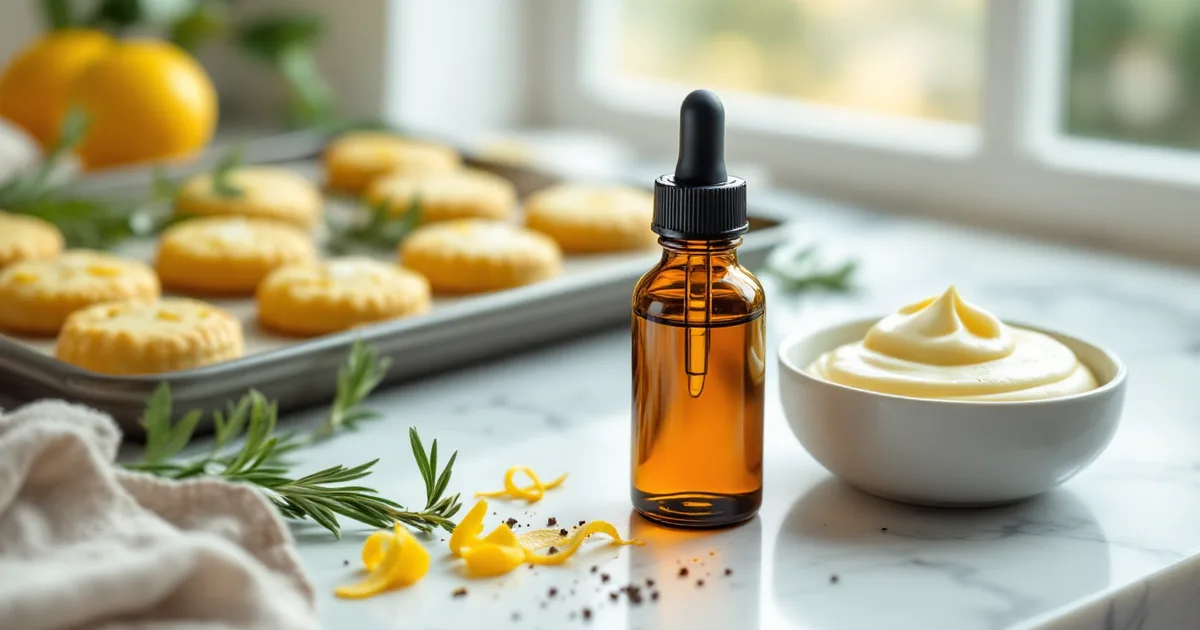

A home oven set to 350°F is running at 177°C. Limonene, the compound behind the smell of lemon and orange peel, boils at about 176°C. That near-tie explains a lot of what goes wrong the first time someone tries cooking with terpenes. The bright top note they paid for is the first thing the oven takes.
This post is for home cooks and small-batch bakers working from a 5 mL bottle: timing, drops, pairings, and what to check first. If you're making edibles to sell, our page on terpenes for edibles is the better starting point.
What cooking with terpenes actually adds
Terpenes in food aren't new. Limonene is the main component of citrus peel oil, which is why zest smells the way it does. Rosemary and dill carry pinene, black pepper and cloves carry caryophyllene, and coriander and sweet basil carry linalool.
A terpene blend concentrates that into a few drops. A cultivar profile layers citrus, pine, pepper and fruit notes in proportions no single herb gives you.
That's all terpenes do in the kitchen. They add flavor and aroma, they aren't intoxicating on their own, and nothing in this post involves cannabis.
Food grade terpenes and GRAS: what to check first
GRAS stands for generally recognized as safe. Anything intentionally added to food needs FDA premarket approval, with one exception. It's exempt if it is "generally recognized, among qualified experts, as having been adequately shown to be safe under the conditions of its intended use." That's the FDA's own definition of GRAS, and "intended use" does a lot of work.
GRAS covers a flavoring at the small amounts used in food, not a concentrate taken by the dropper. It also belongs to individual substances, not to a bottle. Limonene and linalool, for example, are listed by name in the federal regulation on GRAS flavoring substances, 21 CFR 182.60. A blend is only as food-ready as everything in it and the way it was made.
Food grade is a supplier's claim, and it should arrive with paperwork. Before a blend goes into food, check four things:
- A batch COA that matches the lot on your bottle, naming the terpenes rather than calling them proprietary.
- A spec sheet that states the intended use. A blend built for vape hardware isn't automatically built for food.
- What else is in the bottle, including any carrier or diluent.
- A written yes to "is this specific blend food grade?"
As for our own bottles, every Entour™ blend is food grade and safe to cook with, and the myrcene in them is natural. That detail matters, because in 2018 the FDA removed synthetic myrcene from its food additive regulations, while natural myrcene from foods and their extracts kept its status. If you need the paperwork for a particular blend, ask us.
Terpene boiling points versus a 350°F oven
Boiling points show quickly which notes are at risk. These are normal-pressure values from the NIH's PubChem compound database, with Fahrenheit added.
| Terpene | Aroma | Boils at (°C) | Boils at (°F) |
|---|---|---|---|
| Alpha-pinene | Pine needles, woody | 155 to 156 | 311 to 313 |
| Myrcene | Earthy, musky, herbal | 166 to 167 | 331 to 333 |
| Limonene | Citrus peel | 175 to 176 | 347 to 349 |
| Terpinolene | Floral, piney, herbal, citrus | 183 to 187 | 361 to 369 |
| Linalool | Floral, lavender, sweet | 194 to 200 | 381 to 392 |
| Geraniol | Rose, peach, citrus | 229 to 230 | 444 to 446 |
| Caryophyllene | Warm, spicy, peppery | 256 to 259 | 493 to 498 |
A 350°F oven sits at 177°C, above the boiling points of pinene, myrcene and limonene. Those pine, earthy and citrus notes leave first.
Some charts list caryophyllene at 266°F (130°C), but PubChem records that figure at reduced pressure, 14 mmHg. At normal pressure it boils around 493°F (256°C), which makes it the sturdiest terpene in the table, not the most fragile.
Boiling point isn't a cliff, either. In a 2021 study of a linalool-rich leaf oil, 30 minutes at 100°C (212°F) cut linalool from 93% of the oil to 64%. At 150°C (302°F) it fell to 28%, and part of it had turned into myrcene, ocimene and limonene.
So heat turns a blend's volume down and reshapes its profile. The fix is simple: add terpenes late, off the heat, or after cooking.
Do terpenes survive baking at 180°C (about 350°F)?
Partly. Heavier compounds hold up reasonably well, citrus and pine take the biggest hit, and what leaves the oven is a different profile from what went in.
The most useful evidence on terpenes in baking we found is a 2019 study in the Journal of Food Science and Technology. Researchers flavored biscuit dough with cinnamon oil and baked it at 200°C (392°F) for 15 minutes. Then they measured how much of each compound remained compared with the dough.
With the liquid flavoring, cinnamon oil in propylene glycol, the biscuits kept 87% of their cinnamaldehyde and 81% of their caryophyllene. Encapsulating the oil in maltodextrin first raised cinnamaldehyde retention to about 96%.
Caryophyllene boils around 256°C, well above that oven, and still lost roughly a fifth. Pinene, myrcene and limonene boil below 180°C, so they have much less margin. The study didn't measure them, and we haven't found a cookie study that does, so we won't invent a number.
In a home kitchen, that means five habits:
- Put the terpene in the part that doesn't bake. Glaze, frosting, filling or a syrup brushed on afterward skips the oven entirely.
- If it goes in the dough, use the fat. Stir the drops into the softened butter or oil before it meets the flour.
- Pick sturdier profiles for dough. Peppery, caryophyllene-forward blends have the most margin. Citrus and pine have the least, and linalool changes with heat despite its high boiling point.
- Bake one test cookie and adjust the rest of the dough from that.
- On the stove, finish off the heat. Stir terpenes into sauces, custards, caramel and syrups after the pan leaves the burner.
How to use terpenes in cooking: count drops, not milliliters
A 5 mL bottle holds roughly 100 drops, going by the pharmacy convention of 0.05 mL per drop. A 1/8 teaspoon measure holds about 12. Spoons are the wrong tool. Drop size varies with the dropper and the liquid, so use the same dropper every time and your counts stay consistent.
Start with one drop per cup of finished food. Taste it in the food, never from the bottle, then add one drop at a time.
That's less than it sounds. Spread a cup of frosting across 12 cupcakes and each carries about 4 microliters of terpene, a few milligrams.
For scale, our guide to terpene dosing by product type starts commercial edibles at 0.5% of the finished product. A cup of water weighs about 237 grams, so 0.5% of a cup-sized batch is roughly 1.2 grams, or about 28 drops. The same guide warns that at the top of the range, food turns "soapy, perfumed and inedible." You can add a drop. You can't take one out.
Always dilute in fat or oil first. PubChem puts limonene's water solubility at about 7.6 milligrams per liter, so a single drop would need more than five liters of water to dissolve. Dropped straight into a batter, it won't spread evenly.
Stir the drops into a tablespoon of the recipe's own melted butter, oil or cream, then fold that in. For a cocktail, add them to the spirit first, since limonene mixes freely with alcohol. Clear, water-based drinks are the hard case, because the oil floats. Commercial makers use emulsions, which our formulator's guide to edibles and beverages covers.
Matching terpene profiles to food
Start from what the dish already tastes of, then pick the profile that extends it.
- Citrus for desserts and drinks. Limonene-forward blends work anywhere you'd reach for zest: lemon bars, cheesecake, glazes, lemonade, a gin cocktail.
- Pine and herbal for savory food. Alpha-pinene occurs in rosemary, basil, parsley and dill, so pine-forward blends suit compound butter for steak, roasted vegetables and vinaigrettes.
- Pepper and spice for chocolate. Caryophyllene is part of the warm note in black pepper and cloves. It suits brownies, chai-spiced bakes and dry rubs, and it's the best candidate for the oven.
- Floral with honey and berries. Linalool runs through lavender and coriander. Try it in a berry compote or a honey drizzle, added after heat.
- Dessert profiles for frosting and fillings. Buttercream, whipped cream and cheesecake fillings never see an oven, which makes them the safest home for delicate profiles.
For seasonal baking, our post on holiday terpene flavors covers the cold-weather profiles.
Storing terpene-infused food
Terpenes keep oxidizing after they're in the food. Our guide to terpene shelf life and storage covers the chemistry. Oxygen, heat and light do the damage, and the light monoterpenes go first, leaving a blend that smells woodier and flatter.
Baked goods follow the same arc. In the biscuit study above, retention slipped slightly over 45 days of sealed storage, then dropped markedly by day 90.
Keep terpene-finished food airtight and cool, with frostings and dairy fillings in the fridge, and eat it within a few days for the fullest aroma. Store the bottle capped tight and away from the stove.
Handling a terpene concentrate safely
A 5 mL bottle of terpenes is a concentrate. Give it the care you'd give an essential oil.
Never use it neat. Not on the tongue, not as a drop straight into a glass. Dilute it in fat, oil or alcohol first.
Lock it away from kids and pets. The National Capital Poison Center's guidance on essential oils says bottles at home "must be locked up, out of the sight and reach of children and pets." It also warns that choking on a swallowed oil can send some into the lungs and cause pneumonia. Treat terpene bottles the same way.
Know the number. If someone swallows a concentrate, call Poison Control at 1-800-222-1222 or use its online tool.
Keep drops out of hot pans. At frying temperatures you'll mostly be perfuming the kitchen.
Label what you make. Food that smells like a cannabis cultivar can be mistaken for an edible.
FAQ
What are food grade terpenes?
They're terpene products a supplier states are suitable for food, backed by a batch COA and a spec sheet naming food use. Limonene and linalool are GRAS flavorings, but only at their intended use. With other suppliers, ask in writing whether a specific blend is food grade. Every Entour™ blend is.
Can you bake with terpenes?
Yes, with losses. Pinene, myrcene and limonene boil below a 350°F oven, and even caryophyllene lost about a fifth in a biscuit study at 200°C. Mix terpenes into the fat, favor peppery profiles, and bake a test cookie first.
How many drops of terpenes should I use in food?
Start with one drop per cup of finished food, diluted in fat, oil or a spirit, then taste and add one drop at a time. Commercial edibles start around 0.5%, roughly 28 drops in a cup of water, so one drop is a cautious start.
Will terpenes in food get me high?
No. Terpenes are aroma and flavor compounds and aren't intoxicating on their own. Cooking with them adds smell and taste, nothing more.
What foods naturally contain terpenes?
Citrus peel is rich in limonene, and mangoes and hops carry myrcene. Rosemary and dill carry pinene, coriander and basil carry linalool, and black pepper and cloves carry caryophyllene.
Where to take this next
Pick one no-bake recipe, a glaze or a frosting, and start at one drop. Since all of our blends are food grade, a sample pack, six 5 mL bottles for $80, is the easiest way to taste several side by side. Questions about a particular blend? Ask our team.
About the author: The Entour™ team is a division of The Werc Shop®, the first commercial cannabis laboratory to test for terpenes back in 2011. The team formulates True To Plant® terpene profiles for licensed cannabis brands across the US, Canada, and tribal markets.
Read More
Holiday Terpene Flavors: Mint, Spice and Dessert Profiles for the Season
Of the five flavors that announce December fastest (peppermint, cinnamon, clove, vanilla and caramel), only peppermint gets its signature note from a terpene-family compound. That single fact shapes h

Building a Custom Blend Online: What the Entour Blender Does and Does Not Do
The Blender lets you combine two of our blends at a ratio you choose, see the price, and send us the result. It is the shortest path between "I wonder what those two would be like together"

Terpene Yield Loss: What You Order Versus What Reaches the Product
Buy 500 mL of terpene, dose a batch at 5%, and check what is actually in the finished units. The two numbers will not match, and most operators have never measured the gap.