


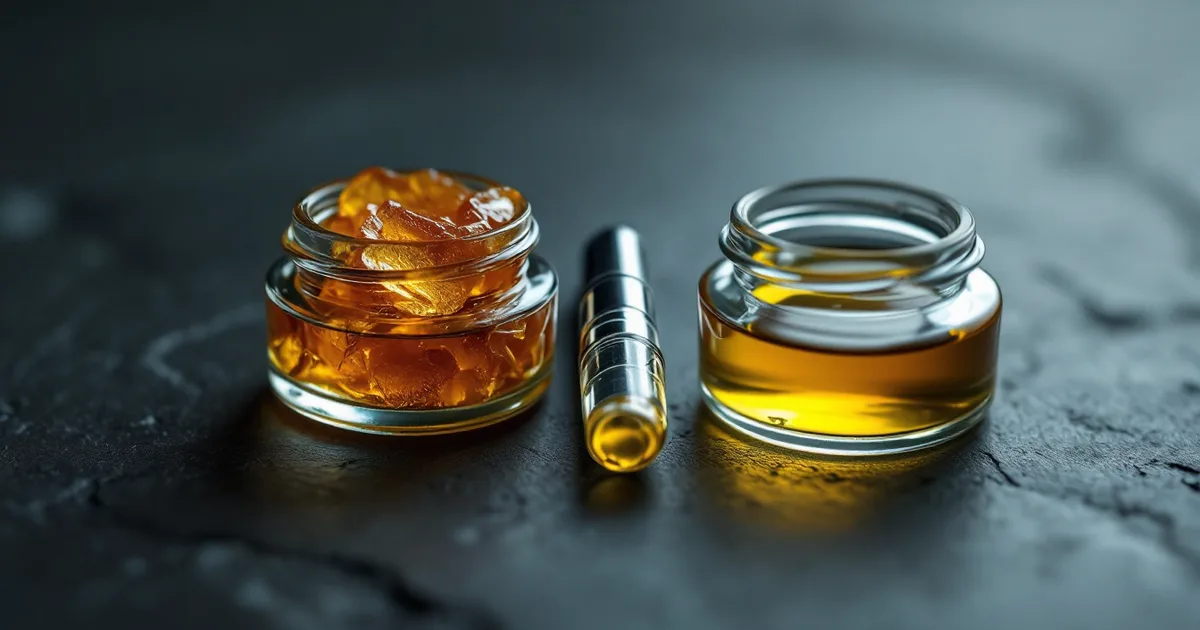

Live resin is a cannabis extract made from plants frozen right after harvest, so it holds on to much of the terpene profile the living plant had. Distillate is a refined oil: a crude extract is distilled until it is mostly cannabinoid, and the terpenes come off along the way. So when a distillate cart smells like OG Kush or tastes of mango, somebody put those terpenes back in, and what they chose decides most of what you taste.
That last step is our line of work. Entour™ formulates the terpene blends that brands add to distillate, so we have a stake in one side of this comparison. Every number below has a source, including the ones that favor live resin.
Flavoring a distillate cart: three places to start
If you are building a distillate cart that should taste of a named cultivar, these are the bottles we would put on the bench first. Both OG Kush listings name limonene as the primary terpene, with myrcene and caryophyllene behind it.
- OG Kush - Live Derived®, from $62.50 for 2 mL. Our premium tier, which the catalog calls "premium terpene formulations" built for "a cultivar-specific authentic essence." It is the tier we point brands toward for flagship carts. Ships to US addresses only.
- Native® OG Kush, from $35 for 5 mL. The same cultivar for a value line. Native® pricing runs from $35 for 5 mL up to $2,650 for a liter.
- Build Your Own Sample Pack, $80. You choose all six bottles. Native®, Inspired® and Effects picks arrive as 5 mL, Live Derived® picks as 2 mL, so both OG Kush tiers fit in one box and can go into the same distillate lot for a fair comparison. A pack with Live Derived® picks ships to US addresses only.
Live resin vs distillate at a glance
| Live resin | Distillate | |
|---|---|---|
| Starting material | Whole plants frozen at harvest and kept frozen | A crude extract, usually from dried plant material |
| Main process | Solvent extraction of the frozen plants, typically butane or propane | Winterizing the crude, then vacuum distillation |
| Terpenes | Keeps much of that harvest's own profile | Mostly removed during distillation |
| Where the flavor comes from | The plant | Terpenes added afterward |
| THC, published figures | Around 60 to 80% for good live resin, per one testing lab | Often above 90% before terpenes go in |
| Shelf price | Premium end of the vape category | Low end of the vape category |
| Batch to batch | Shifts with every harvest | Base is uniform; flavor is only as steady as the terpene supply |
How live resin is made
Live resin skips the drying room. Plants are frozen as soon as they are cut, held frozen through extraction, and run with a solvent such as butane or propane. The solvent is purged, often in a vacuum oven, and the oil is jarred or filled into carts.
The reason for all that cold handling is that drying costs terpenes, and the lightest ones go first. In a 1996 study, Ross and ElSohly compared the volatile oil from fresh and air-dried cannabis buds. Fresh buds gave 0.29% oil by weight. One week of drying brought that to 0.20%, and three months later it was 0.13%. Monoterpenes, the group that includes citrusy limonene and piney pinene, dropped further than the heavier sesquiterpenes. None of the major compounds vanished. There was simply less oil, and what remained leaned toward its base notes.
Freezing is meant to stop that loss before it starts. It is why people reach for live resin when they want an extract that smells the way the plant did on harvest day.
Two close relatives share the frozen input. Live rosin skips the solvent and uses heat and pressure instead. And live resin can be left to separate into THCA crystals sitting in a terpene-rich liquid, sold together as sauce. That liquid on its own is usually called high terpene extract, which our guide to what HTE is explains in full.
How distillate is made
Distillate is built for purity. Processors start with a crude extract, commonly pulled with ethanol, hydrocarbon or CO2, then winterize it in cold ethanol to drop the plant waxes. The winterized oil goes through a vacuum still, often a short path or wiped film setup. As chemist Jason Lupoi puts it in Extraction Magazine, distillation boosts potency while terpenes are "fractionated off" along with pigments and minor cannabinoids, which is why he says distillate isn't full spectrum.
What comes out is a thick oil with very little smell. That neutrality is useful. The same distillate can go into a gummy, a drink or a cart, and every flavor decision gets made later by whoever adds the terpenes.
Flavor: grown in one, formulated in the other
A live resin cart tastes of its harvest. When the grow and the extraction both go well, it can be the closest a vape gets to the flower. The catch is that the next harvest won't taste identical, because no two crops carry exactly the same terpene profile.
A distillate cart tastes of its blend. Build that blend from three loud terpenes and the cart reads as generic. Build it from a full cultivar profile, minor compounds included, and it can read as the strain on the label. What you gain is control: the blend is a specification, so the cart you sell in month ten can match the one you launched with. Which profiles hold up best in distillate is its own topic, covered in our guide to terpenes for distillate.
Cannabinoid content: what the published numbers say
THC figures for concentrates swing widely by product, state and source, so read any single figure as a rough guide. A 2021 research review by Bidwell and colleagues puts most concentrates at 52 to 69% THC, with some reaching 90 to 95%, compared with 16 to 21% for average legal-market flower.
For these two formats specifically, the clearest figures we found come from a testing lab. Alec Dixon, a co-founder of SC Labs, told High Times that good live resin "should be anywhere from 60 to 80%" THC, and set that against distillate "in the 90s."
Distillate's number falls once it becomes a cart, because every gram of terpene displaces a gram of oil. Our vape formulation page puts typical distillate loading at 8 to 12% terpene by weight. At 10%, distillate that tested at 90% THC lands at about 81% in the finished cart. For any real product, the batch's lab report is the number to trust.
Price: why live resin usually costs more
Live resin sits at the expensive end of the vape aisle. Headset, which tracks US dispensary sales, reports in its vapor pen category data for October 2025 to September 2026 that live resin and all-in-one disposable formats "still command a clear premium over basic distillate," with half-gram distillate carts at the bottom of the range.
The process explains most of the gap. Live resin needs plants frozen at harvest and kept cold until extraction, and a strain-specific run is usually tied to one harvest of one cultivar. Distillate can be made from dried material, stored, and flavored later for whichever product needs it, which spreads its cost over far more units.
Cured resin vs live resin
These two use the same kind of extraction and differ in what goes in. Cured resin comes from plants that were dried and cured first. Live resin comes from plants that were never dried. When a menu says "resin" without "live," or lists shatter, wax or batter, it usually means cured material.
Given the drying data above, you would expect cured resin to carry a smaller share of monoterpenes and lean harder on its sesquiterpene base, the peppery and woody notes. It also matches how the two are usually described, live resin as brighter and closer to fresh flower, cured resin as deeper and more muted. Cured resin is also simpler to schedule, since dried material can sit in storage until the extraction lab has capacity.
Live resin terpenes, live terps and other label words
Live resin terpenes are terpenes recovered from fresh frozen plants during extraction and sold on their own. They are one kind of cannabis-derived terpene, and our CDT guide covers how they are produced and what they cost.
A cart sold with "live terpenes" or "live terps" usually holds distillate with terpenes like these added back. That is a different product from a cart filled with live resin, where the whole extract came from frozen plants. The wording isn't standardized, so the ingredient list or the lab report tells you more than the front of the box.
One name to clear up, since it is ours. Live Derived® is the name of a product line. Adding it, or any other terpene blend, to distillate produces a flavored distillate cart, not a live resin cart, and the label should say which one the customer is buying.
Where a distillate cart's terpenes come from
They come from three broad sources.
- Cannabis-derived terpenes, including live resin terpenes and HTE. These are the plant's own compounds, and their price and availability move with the harvests behind them.
- Single botanical terpenes stacked to approximate a strain. Limonene from citrus is the classic example. Cheap and easy to source.
- Strain-matched botanical blends. This is where our True To Plant® profiles sit. Our parent lab, The Werc Shop®, dates to 2010, and its terpene testing to 2011. Each profile is rebuilt from real cultivar data and checked for consistency by GC-MS, across a library of 150+ strain blends.
What this means for a brand choosing a cart format
Start from what the product promises the customer.
- A specific harvest, farm or limited drop. Live resin is the honest format, and harvest-to-harvest variation becomes part of the story.
- The same taste in every store, every month. Distillate with a fixed blend, because the flavor is written down as a spec rather than grown.
- A sharp shelf price. Distillate with a value-tier blend keeps the input cost down.
Most lines end up with more than one tier. In our premium tier cost breakdown, Live Derived® goes "on the flagship carts," while Native® belongs "on the value line" and Inspired® "on anything flavor-led." That guide also works out what the premium adds per cart. Before you commit either way, run both tiers through the same distillate and hardware and taste them blind. For a bigger bench batch, 30 mL costs $170 for Native® and $200 for Live Derived®.
FAQ
Is live resin better than distillate?
Neither wins on every count. Live resin keeps more of a harvest's own terpenes and usually costs more. Distillate starts higher in THC, costs less, and takes its flavor from whatever is added, which makes it the more predictable of the two from batch to batch.
Does distillate have more THC than live resin?
Usually, before terpenes go in. A testing-lab co-founder quoted by High Times put good live resin at 60 to 80% THC and distillate in the 90s. Adding terpenes for a cart dilutes the distillate by the loading percentage, so finished carts read lower than the raw oil.
What is the difference between cured resin and live resin?
The starting material. Cured resin is extracted from dried, cured plants, and live resin from plants frozen at harvest and kept frozen. Drying costs a share of the terpenes, monoterpenes most of all, so live resin generally carries a brighter version of the plant's aroma.
Why are live resin carts more expensive than distillate carts?
Frozen input, cold handling and runs tied to single harvests make live resin costlier to produce. Headset's US sales data shows live resin vape formats selling at a premium over basic distillate, while distillate can be made in bulk from dried material and flavored later.
What are live resin terpenes?
Terpenes captured from fresh frozen plants during extraction and sold separately, mostly to flavor distillate. They are a type of cannabis-derived terpene. A cart labeled "live terpenes" generally contains distillate plus terpenes like these, not live resin itself.
Do distillate carts have terpenes in them?
Almost always, and every one of them was added. Distillation removes the plant's own, so the terpenes in a distillate cart come from cannabis-derived sources, single botanical terpenes, or strain-matched botanical blends like ours.
Where to take this next
If your carts run on distillate, the terpene blend is the flavor, so test it before you scale it. Put Native® OG Kush and its Live Derived® version side by side in a Build Your Own Sample Pack for $80 and run both through your own oil and hardware. Formulating for a brand at volume? Talk to our formulation team about tiers, documentation and pricing.
About the author: The Entour™ team is a division of The Werc Shop®, the first commercial cannabis laboratory to test for terpenes back in 2011. The team formulates True To Plant® terpene profiles for licensed cannabis brands across the US, Canada, and tribal markets.
Read More
How to Choose a White Label Terpene Supplier: 12 Questions to Ask
A white label terpene supplier formulates the terpene blend and sells it to you, and your brand is the only name on the finished product. To choose one, put the same twelve questions to every candidat
What Is HTE? High Terpene Extract, Terp Sauce and HTFSE Explained
HTE stands for high terpene extract. It is the runny, aromatic fraction of a hydrocarbon cannabis extract, the "sauce" that THCA crystals form in, collected and sold as a product of its own.
Terpene Chart: 18 Cannabis Terpenes by Aroma, Boiling Point and Effect
A terpene chart lines up the aromatic compounds in cannabis so you can compare them at a glance: what each one smells like, where else it grows, when it boils, and what research has tied it to. Ours c