


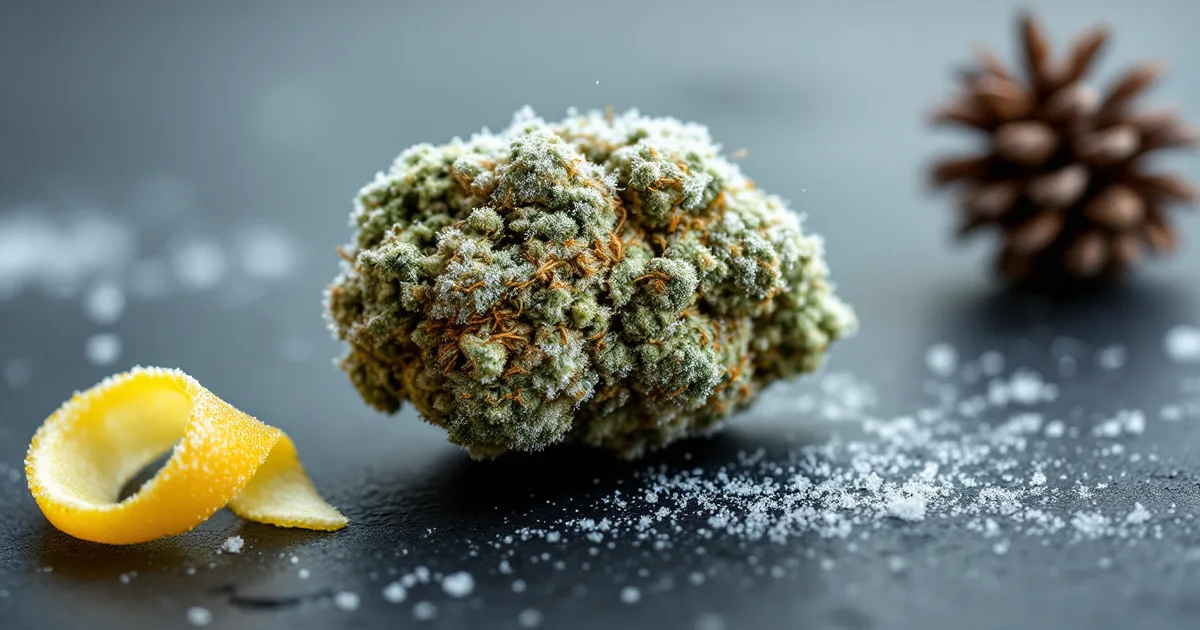

In 2015, our parent lab, The Werc Shop®, published a paper that grouped 494 California flower samples by their chemistry instead of by the names on their labels. When the authors pulled out the OG-type and Kush-type samples and compared them, SFV OG sat with the OGs, alongside True OG, Tahoe OG, Fire OG and Larry OG.
That is a useful anchor, because little else about the SFV OG strain is settled. Its type label changes from one database to the next. Its lineage gets written two different ways. And the three terpenes usually listed for it, myrcene, limonene and caryophyllene, are the same three that headline OG Kush itself.
This guide covers one strain in depth. For SFV OG next to the other famous OG cuts, see our roundup of the best OG strains and their terpene profiles. Here we stay with one plant: its origin, its published lab chemistry, what people report, and how Entour™ builds it as a Native® blend.
SFV OG at a glance
| Trait | Detail |
|---|---|
| Also known as | San Fernando Valley OG, San Fernando Valley Kush |
| Family | OG Kush |
| Seed version | SFV OG Kush from The Cali Connection (San Fernando Valley OG x Afghani) |
| Type | Disputed: hybrid, sativa-dominant hybrid and indica all appear |
| Most abundant terpene | Myrcene, then limonene and caryophyllene (Leafly) |
| OG marker compounds | α-terpineol, fenchol, limonene, camphene, terpinolene, linalool (Elzinga et al., 2015) |
| Aroma | Pine, lemon and earth, with a kerosene and fuel edge |
| Reported feelings | Focused, relaxed, happy (Leafly) |
| Potency | Rated higher THC than average (Leafly) |
| Entour™ blend | SFV OG, Native® line, limonene-forward |
What is the SFV OG strain?
SFV OG, short for San Fernando Valley OG, is an OG Kush-family cultivar named for the San Fernando Valley in Los Angeles. The name covers two related plants, and separating them clears up most of the confusion you will find online.
The original SFV OG
The first is the original plant. The Cali Connection's listing for SFV OG Kush traces the strain's origins "from Tahoe to the OC, and then to the SFV," where it was "ultimately introduced to the world by the renowned Swerve," the breeder whose company sells it. That is the most direct account available, and it comes from the people with the biggest stake in the story.
The seed line: SFV OG Kush
The second is SFV OG Kush, the seed version. On the same listing, The Cali Connection gives the genetics as San Fernando Valley OG crossed with Afghani, "worked to IBL" through breeding and back-crossing. IBL stands for inbred line, meaning seed bred toward stable, predictable offspring. The breeder describes the result as a thick-stemmed classic OG with a kerosene fragrance.
Leafly keeps the two as separate entries. Its SFV OG Kush page lists the parents as SFV OG and Afghani, matching the breeder, but the description on that same page says SFV OG crossed with OG Kush. When a database disagrees with itself, we go with the breeder.
What nobody can settle
Further back, the record runs out. OG Kush itself has no agreed parentage, as our OG Kush terpene profile notes, so any family tree drawn above SFV OG leans on oral history. Treat lineage charts that quote exact indica and sativa percentages with healthy skepticism.
What does SFV OG smell like?
SFV OG smells like pine, lemon and earth, with a fuel note underneath that marks it as an OG. Leafly's SFV OG users put pine, earth and wood at the top of its flavor list. Our product page for the blend opens with "earthy aromas reminiscent of lemon and pine," and the breeder points to a "fusion of kerosene and fuel notes."
There is a softer side too. Our SFV OG notes move from lemon and pine into ylang-ylang and "after-sunset blooms," with orange, cherry soda and breakfast-cereal marshmallow in between.
Mapping smell to chemistry is rough, but a few links are solid. Limonene is the citrus terpene, covered in depth on our limonene page. Myrcene reads herbal and earthy. Caryophyllene brings a peppery, woody bite. None of those three smells like fuel on its own, which is why the gas note is the hardest part of an OG to reproduce and the first thing a thin blend loses.
SFV OG terpene profile: what the lab data shows
Two kinds of published data exist for SFV OG, and they answer different questions. One tells you which terpenes are biggest. The other tells you which compounds make it an OG.
The headline ranking
Leafly reports that "the most abundant terpene in SFV OG is myrcene, followed by limonene and caryophyllene." Our Native® SFV OG blend is built the other way round at the top: limonene is listed as primary, with caryophyllene and myrcene as secondary terpenes.
The top terpenes we list are verified as what's actually in the blend. Where they part ways with Leafly, rampant misnaming across the industry is the cause. Pooled data can include flower sold as SFV OG with no real link to the original cut, and growing conditions move the profile even when the cut is real.
Those rankings are closer than they look. In a 2017 study of 233 samples from a single California dispensary, Justin Fischedick found that OG Kush-group cultivars "tended to dominate in myrcene with similar or slightly lower levels of limonene." SFV OG was not among its 30 cultivars, but when two terpenes sit that close, phenotype, growing conditions and harvest timing can swap their order between batches.
What makes it an OG, chemically
The more interesting finding is in the 2015 Werc Shop paper, Cannabinoids and Terpenes as Chemotaxonomic Markers in Cannabis, by Elzinga, Fischedick, Podkolinski and Raber. In its OG versus Kush comparison, the OG group that included SFV OG was "characterized mainly by the compounds α-terpineol, fenchol, limonene, camphene, terpinolene and linalool." The Kush samples were characterized by trans-ocimene, guaiol, β-eudesmol, myrcene and α-pinene.
In a comparison like this, "characterized by" points to the compounds that pull a sample toward one group rather than the other. It is not a list of the largest peaks. Myrcene can still be the biggest number on an SFV OG lab report while fenchol, α-terpineol and linalool do the work of making it read as OG.
Fischedick's 2017 data, from a different sample source and a later period, points the same way. The group holding OG Kush, Tahoe OG Kush and several other cultivars, most of them OG-named, was distinguished by "relatively higher levels of the monoterpenoid alcohols α-terpineol, endo-fenchyl-alcohol, and linalool." Fischedick also co-authored the 2015 paper, so read this as consistent results rather than fully independent confirmation.
A monoterpenoid alcohol is a terpene with an alcohol group attached. Linalool is the best known of them, the floral compound familiar from lavender. Fenchol and α-terpineol are far less famous, and they rarely make a three-terpene summary.
One caveat covers all of it. The 2015 samples were submitted by medical patients under strain names, so the data reflects what was sold as SFV OG at the time. It cannot tell you whether a given sample was the original plant or seed-grown SFV OG Kush.
What effects do people report with SFV OG?
Most reports describe a focused, upbeat experience with some relaxation mixed in. Leafly's summary is that "SFV OG effects are mostly energizing," and its users most often report feeling focused, relaxed and happy. Dry mouth tops the list of negatives.
Our product description leans the other way, calling SFV OG known for long-lasting body effects and calming character. A cultivar reported as focused and relaxed at once is exactly the kind that collects both "sativa" and "indica" labels.
Keep the chemistry in proportion. Terpenes are not what makes cannabis intoxicating; cannabinoids are, as we explain in terpenes vs THC. Terpenes shape aroma and flavor, and how much they shape the experience itself is still being studied. Reported effects also vary from person to person.
Who SFV OG suits
SFV OG suits people who like the classic OG nose of lemon, pine and fuel and prefer the more focused side of the family that Leafly's reviewers describe.
For the heavier end, look at the seed line instead: Leafly labels SFV OG Kush an indica "known for its sedating and relaxing effects."
For brands, SFV OG can sit next to OG Kush on a menu, but the gap between them is in the detail. Our SFV OG and OG Kush Native® blends both list limonene as their primary terpene. What separates them is the rest of the profile: SFV OG runs to ylang-ylang and evening florals, while our OG Kush heads toward garden herbs and citrus jam.
How Entour™ recreates SFV OG
Entour™ sells SFV OG in our Native® line, described on the site as "Authentic, cultivar-specific botanical terpene formulations": a blend built from botanical ingredients to match one named cultivar, rather than a generic OG recipe with a new label.
The SFV OG product page lists limonene as the primary terpene, caryophyllene and myrcene as secondary terpenes, and OG Kush as the cultivar base. Its notes run from earthy lemon and pine into ylang-ylang, and it sums up the mood as "Sneaking snacks into a double-feature."
The profile is built with our True To Plant® process, which fingerprints a cultivar's terpene profile and rebuilds it from botanical sources. Our guide to True To Plant vs generic strain profiles explains why that matters. For SFV OG, the lab data above makes the case: the compounds that separate an OG from a Kush include several that never make a top-three list.
The product page does not publish target percentages, so we will not claim the blend matches any specific lab result quoted here. It runs from a 5 mL bottle at $35 up to a liter at $2,650, and it sits in our Native® blends range with other OG cultivars, including Tahoe OG and True OG.
FAQ
Is SFV OG indica or sativa?
Sources disagree. Leafly labels SFV OG a hybrid and notes four phenotypes, "three of which typically express sativa influence." Our product page calls it a sativa-dominant hybrid, and Leafly labels the SFV OG Kush seed line an indica. Fischedick's 2017 paper notes that cannabis cultivars are named "using obscure and inconsistent nomenclature," which is why we lean on lab data over labels.
What terpenes are in SFV OG?
Leafly lists myrcene as the most abundant, followed by limonene and caryophyllene. The 2015 Werc Shop paper grouped SFV OG with OG cultivars characterized by α-terpineol, fenchol, limonene, camphene, terpinolene and linalool. Our Native® blend leads with limonene, backed by caryophyllene and myrcene.
What does SFV OG smell like?
Pine, lemon and earth, with a kerosene and fuel edge the breeder highlights. Leafly's users report pine, earth and wood as the top flavors. Our blend also carries a floral, ylang-ylang side behind the citrus.
How strong is SFV OG?
Leafly rates its potency as higher THC than average, but strength varies by grower, phenotype and batch. A terpene profile tells you about aroma and flavor, not potency. The reliable number is the cannabinoid result on the Certificate of Analysis for the specific product in front of you.
Is SFV OG the same as SFV OG Kush?
Not quite. SFV OG is the original plant. SFV OG Kush is The Cali Connection's seed line, which crosses San Fernando Valley OG with Afghani and was worked to an inbred line. They share a parent and most of a name, so check which one a label actually means.
Where to take this next
To smell the profile this guide describes, find your strain profile on the SFV OG Native® blend page, starting at 5 mL. If you need it at production volume or matched to your own target, talk to our formulation team.
About the author: The Entour™ team is a division of The Werc Shop®, the first commercial cannabis laboratory to test for terpenes back in 2011. The team formulates True To Plant® terpene profiles for licensed cannabis brands across the US, Canada, and tribal markets.
Read More
Banana Kush Strain: Terpene Profile, Flavor and Effects
The breeder behind the Banana Kush strain named it for its "faint banana smell." Leafly describes the same cross as one that "tastes and smells like a bushel of fresh bananas." Bot
Permanent Marker Strain: Terpene Profile, Aroma and Effects
In August 2022, the Permanent Marker strain was on 10 store menus in the US. By November 2023 it was on 587, a 59x jump that Leafly says made it the fastest-growing new strain on US menus that year. L
Super Lemon Haze Strain: Terpene Profile, Aroma and Effects
Super Lemon Haze took first place at the High Times Cannabis Cup in 2008 and again in 2009, and its name is a fair summary of the aroma. The Super Lemon Haze strain leads with sharp lemon zest. The ch