


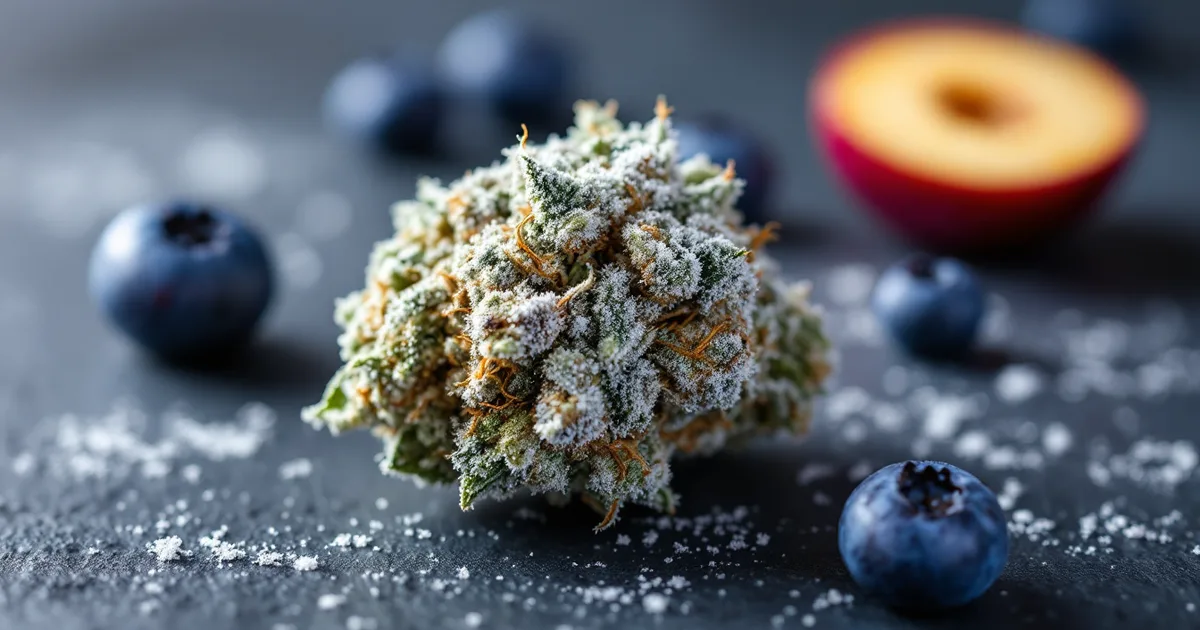

The Purple Punch strain is one of the few cannabis names that holds its shape from one grower to the next. A 2022 study in PLOS ONE sorted more than 42,000 US lab samples by their terpene chemistry. Of the Purple Punch products in that data, 96% landed in the same group, the one led by caryophyllene and limonene.
That consistency sits under an aroma people describe as grape candy and blueberry muffins. The chemistry is less obvious, because the top terpene is the peppery one and neither parent strain ranks it first. Below, we cover where Purple Punch came from, what the lab data shows, the effects users describe, and how we rebuild it as a Native® blend.
| Quick facts | Purple Punch |
|---|---|
| Type | Hybrid, indica-leaning |
| Lineage | Larry OG x Granddaddy Purple |
| Breeder | Supernova Gardens |
| Wider release | F2 seeds from Symbiotic Genetics, April 20, 2017 |
| Dominant terpene | Caryophyllene |
| Next in line | Limonene, then pinene or α-bisabolol depending on the source |
| Aroma and flavor | Grape candy, blueberry muffin, plum, berry, a tart edge |
| Most reported feelings | Sleepy, relaxed, hungry |
| THC listed by Leafly | 18% |
| Entour™ blend | Purple Punch, Native® line |
What is the Purple Punch strain?
Purple Punch is an indica-leaning hybrid bred by Supernova Gardens from a cross of Larry OG and Granddaddy Purple. Leafly's Purple Punch page lists the same two parents, and Cannabis Now's 2018 strain review credits Supernova Gardens as the original breeder. Our own product page dates the cross to 2013.
The parents come from opposite corners of the flavor map. Granddaddy Purple is the grape-and-berry side, which we break down in our Granddaddy Purple terpene profile. Larry OG is the OG side, a cross of OG Kush and SFV OG according to Leafly, tagged with lemon, pine and citrus flavors.
On the nose, the child takes after its purple parent. Leafly's flavor tags for Purple Punch are grape, plum and berry, with no trace of Larry OG's lemon or pine.
How Purple Punch spread
According to Cannabis Now, a breeder known as The Village was the first to grow Purple Punch at full production scale. The cut reached The Village through a grower called Budologist, with Supernova's blessing.
On April 20, 2017, the pair's seed company, Symbiotic Genetics, released the first F2 Purple Punch seeds in California. F2 means second-generation seed, bred from plants of the original cross. Cannabis Now adds that eight months later, major cannabis publications named Purple Punch their strain of the year, though the review does not say which ones.
What does Purple Punch smell and taste like?
Purple Punch smells like grape candy and blueberry muffins with a tart finish. Leafly describes the aroma as grape candy, blueberry muffins and "tart Kool-Aid," and lists its flavors as grape, plum and berry.
Growers reach for the same kind of comparison. The Village told Cannabis Now that four weeks into flower, the plants smelled like blue Powerade.
Our tasting notes for the Native® blend point the same way. Blueberry muffin, grape candy, candied plum and red currant come first, then rose water, chalky soil and a juniper-heavy gin note on the finish.
The odd part is that none of that fruit comes from the terpene at the top of the chart. Caryophyllene is the warm, peppery compound also found in black pepper and cloves. Limonene is the citrus-peel terpene. Neither one smells like grape.
The most likely explanation is the full mixture. Aroma comes from many volatile compounds acting together, including minor ones present at a fraction of a percent that never make a top-three list. It is also why a blend assembled from only the loudest few terpenes tends to smell flat, which we unpack in our piece on how fingerprinting changes a strain profile.
Purple Punch strain terpenes: what the lab data shows
Caryophyllene leads and limonene follows. That top two holds across every source we checked, and only the third slot moves.
- Leafly's lab data. Leafly names caryophyllene as the dominant terpene, then limonene and pinene. It says the figures come from products tested in Leafly Certified labs.
- The 2022 PLOS ONE study. Smith, Vergara, Keegan and Jikomes grouped THC-dominant samples into three terpene clusters. Cluster I runs high in caryophyllene and limonene, and 96% of Purple Punch product averages fell inside it. By contrast, only 62.5% of Tangie products landed in any single cluster.
- Our fingerprint. The product page for our Native® Purple Punch lists caryophyllene as primary, limonene as secondary and α-bisabolol as tertiary.
The researchers chose Purple Punch as their example of a consistent strain name, with Tangie as the inconsistent one. For a strain name, that is a useful vote of confidence from a dataset this large.
Pinene versus α-bisabolol in third place is a genuine disagreement, but a small one. Different cuts, grows and lab panels can reshuffle the minor terpenes, which is why a COA tells you more than a strain label does. Our terpene testing and COA guide covers what to check first.
Leafly's pool has a wider blind spot too. It counts whatever was sold as Purple Punch, and with strain names applied as loosely as they are across the industry, some of that flower may have no real link to the Supernova Gardens cross.
Caryophyllene: the peppery base
Caryophyllene gives Purple Punch its warm, spicy undertone, and it is chemically unusual. A 2008 PNAS paper by Gertsch and colleagues showed that it binds selectively to the CB2 cannabinoid receptor, with no significant binding at CB1. The same paper describes it as common in the essential oils of many spice and food plants. Our caryophyllene profile covers where else it turns up.
Limonene: the citrus lift
Limonene brightens the top of the profile and stops the dessert notes from going heavy. Our limonene page lists juniper berries among its sources alongside citrus peel. That makes the gin note in our tasting notes less surprising than it first sounds.
α-Bisabolol: the soft floral layer
α-Bisabolol is the third terpene in our fingerprint. It has a delicate floral, honey-like aroma and is best known from German chamomile, as our bisabolol guide explains. In Purple Punch it sits underneath the fruit rather than leading.
Why the parents do not predict the ranking
One detail in the data surprised us. Both parents test myrcene-first. Leafly lists myrcene as the dominant terpene in Larry OG, and our Granddaddy Purple profile describes GDP as strongly myrcene-dominant. Their offspring still comes out caryophyllene-led.
A cross is not the midpoint of its parents. The Purple Punch that went commercial traces back to one selected cut, and a single selected plant can express a ranking neither parent shows. For a formulator, the lesson is to work from the strain's own lab data rather than its family tree.
Reported effects of the Purple Punch strain
Purple Punch is reported as a relaxing, evening-leaning strain. On Leafly, the feelings users mention most often are sleepy, relaxed and hungry. The most common negatives are dry mouth, dry eyes and dizziness.
Leafly describes a one-two punch that lands "between the eyes" before settling into the limbs, and pitches it as an after-dinner strain. Our product page describes the same arc, starting between the eyes and working down into the limbs.
Two caveats belong next to any list like this. Terpenes on their own are not intoxicating; THC does that work, and terpenes are associated with how the experience gets described. These are also self-reported impressions rather than controlled measurements, so individual experience varies.
If you assumed a sleepy reputation means a myrcene-heavy strain, Purple Punch is a useful counterexample. The PLOS ONE authors also found that products in the caryophyllene-limonene cluster were no more likely to carry an Indica label than the market as a whole. Effect labels and terpene chemistry line up far less neatly than dispensary menus suggest.
Who Purple Punch suits
For consumers, Purple Punch fits people who prefer fruit and dessert flavors to fuel and gas, and who want a strain users describe as an evening choice. The name is also a fairly reliable guide to aroma, given how consistently it tests.
For brands, the profile has real advantages. The name is widely recognized, and the grape-dessert aroma reads clearly in a vape cart or an infused pre-roll. On top of that, the chemistry behind the name is consistent enough that customers arrive with a fixed expectation.
That last point cuts both ways. A Purple Punch product that smells like generic grape, or that leans myrcene-first, will feel wrong to anyone who knows the strain. When you assess a supplier's version, confirm the COA puts caryophyllene and limonene at the top before you look at anything else.
How Entour™ recreates Purple Punch
We sell Purple Punch as part of our Native® range, which the site describes as "authentic, cultivar-specific botanical terpene formulations." The product page lists it as a hybrid, with caryophyllene primary, limonene secondary and α-bisabolol tertiary.
The blend comes out of our True To Plant® process. We analyze a cultivar at high resolution, covering far more compounds than a standard terpene panel reports, then rebuild the profile with natural, non-cannabis botanical ingredients. The product page notes that the blend is lab tested, with an SDS and a COA available.
The goal in the bottle is the peppery base, the citrus lift and the grape-and-plum fruit arriving together, so the profile reads as Purple Punch rather than as a grape flavoring.
Sizes start at 5 mL for $35 and top out at a liter for $2,650. The 5 mL size is the sensible starting point, because it lets you hear the profile in your own base before you commit to volume.
FAQ
Is Purple Punch indica or sativa?
Purple Punch is a hybrid that leans indica. Leafly and our product page list it as a hybrid, while Cannabis Now's strain stats label it indica. Leafly calls it a union of two indica-dominant classics, and the effects users report sit on the relaxing side.
What terpenes are in Purple Punch?
Caryophyllene is the dominant terpene, with limonene second. Leafly's lab data puts pinene third, and our Native® fingerprint lists α-bisabolol third. In the 2022 PLOS ONE study, 96% of Purple Punch products fell into the high caryophyllene-limonene cluster.
What does Purple Punch smell like?
Grape candy and blueberry muffins, with a tart, fruit-punch edge and plum and berry on the palate. Under the fruit sits a light peppery warmth, which comes from caryophyllene.
How strong is Purple Punch?
Leafly lists it at 18% THC, but any single number depends on the grow and the test. Cannabis Now reports that one early batch read 12% on an infrared machine at Harborside, then tested at 18% at Steep Hill. Go by the COA for the batch you are actually buying.
Who bred Purple Punch?
Supernova Gardens bred the original Larry OG x Granddaddy Purple cross. The Village was the first to grow it at full production scale, and Symbiotic Genetics released F2 seeds on April 20, 2017.
Where to take this next
If you are building a grape or dessert SKU, start with a 5 mL bottle of Native® Purple Punch and try it in your own base before you scale. For volume, custom ratios or a second opinion on a supplier's COA, talk to our formulation team.
About the author: The Entour™ team is a division of The Werc Shop®, the first commercial cannabis laboratory to test for terpenes back in 2011. The team formulates True To Plant® terpene profiles for licensed cannabis brands across the US, Canada, and tribal markets.
Read More
Banana Kush Strain: Terpene Profile, Flavor and Effects
The breeder behind the Banana Kush strain named it for its "faint banana smell." Leafly describes the same cross as one that "tastes and smells like a bushel of fresh bananas." Bot
SFV OG Strain: Terpene Profile, Aroma and Effects
In 2015, our parent lab, The Werc Shop®, published a paper that grouped 494 California flower samples by their chemistry instead of by the names on their labels. When the authors pulled out the OG-typ
Permanent Marker Strain: Terpene Profile, Aroma and Effects
In August 2022, the Permanent Marker strain was on 10 store menus in the US. By November 2023 it was on 587, a 59x jump that Leafly says made it the fastest-growing new strain on US menus that year. L