


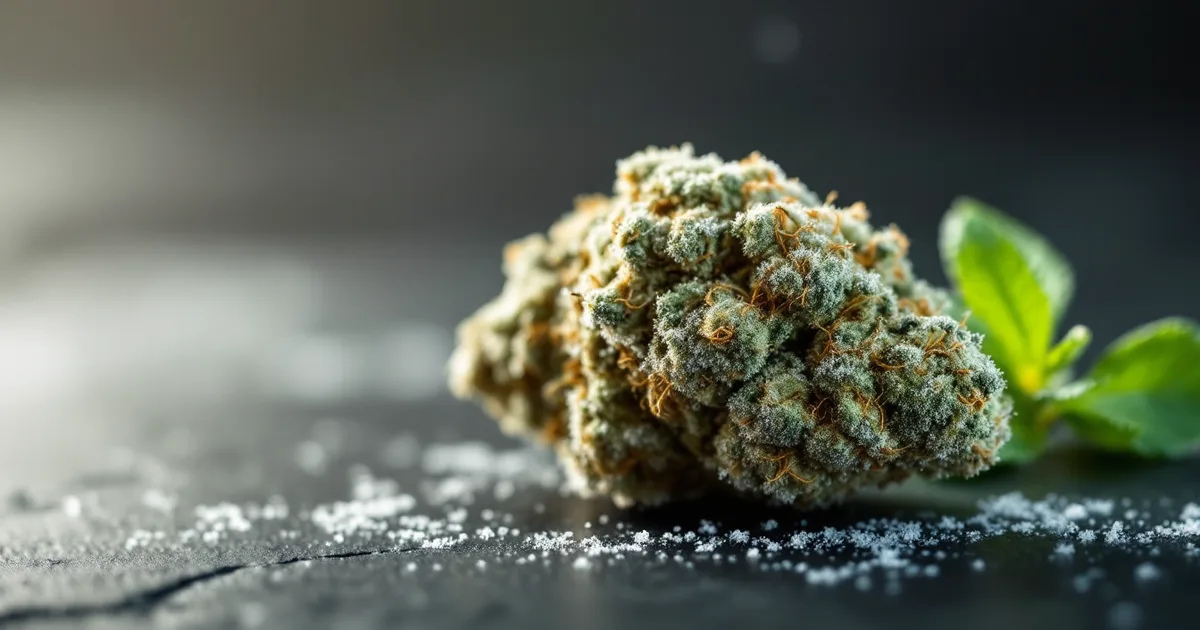

The breeder behind the Banana Kush strain named it for its "faint banana smell." Leafly describes the same cross as one that "tastes and smells like a bushel of fresh bananas." Both descriptions hold up, and the distance between them says a lot about where cannabis aroma comes from.
This guide covers the lineage, the published terpene data, the effects people report and the chemistry behind that banana note, which likely owes more to minor compounds than to the main terpenes. Then we explain how the Entour™ team builds a banana profile that stays put from bottle to bottle.
Banana Kush at a glance
| Trait | Details |
|---|---|
| Type | Hybrid |
| Breeder | Crockett Family Farms |
| Also known as | Crockett's Banana Kush, Private Reserve |
| Parents | Ghost OG x Skunk Haze |
| Leading terpenes (Leafly lab data) | Limonene, myrcene, caryophyllene |
| Aroma and flavor | Ripe banana and tropical sweetness over cream, earth and pepper |
| Most reported effects | Relaxed, talkative, euphoric |
| Most reported negatives | Dry mouth, dry eyes, headache |
| THC listed by Leafly | 21% |
| Entour™ blend | Banana Kush, Inspired® line |
What is the Banana Kush strain?
Banana Kush is a hybrid bred by Crockett Family Farms from Ghost OG and Skunk Haze. Leafly's Banana Kush page lists the same two parents, and Weedmaps carries the strain under the alias Crockett's Banana Kush.
The breeder's own account, reproduced on SeedFinder's Banana Kush entry, is the best primary source we found. He searched a long time for a particular OG Kush cut called Ghost OG and kept it for its nug size and yield. He then crossed it with a local Skunk variety he calls an ancestor of the Haze "that everybody in Amsterdam is crazy over." Those Skunk Haze seeds, he says, date back to the early seventies.
He called the result Banana, found the name was already in use, and renamed it Private Reserve. Locally, it stayed Banana. His logic for the pairing was contrast: "The OG is so indica and the Skunk Haze is so sativa."
A second version circulates. Weedmaps notes that Cali Kush "has also claimed a Banana Kush bred from OG Kush and a male known simply as Banana." Most strain databases go with the Crockett cross, and so do we. If a seed bank or menu lists different parents, that competing claim is the likely reason.
Where the "Kush" comes from
The Kush in the name arrives through Ghost OG, which is a cut of OG Kush. That puts Banana Kush somewhere very different from Afghan Kush, a landrace indica from the Hindu Kush mountains. Banana Kush is a modern cross with Skunk Haze on one side. For the chemistry the OG half brings on its own, see our OG Kush terpene profile.
Banana Kush has since become a parent in its own right. Leafly lists Strawberry Banana and Tropicana Banana among its offspring.
What does Banana Kush smell and taste like?
Ripe banana arrives first, with something heavier underneath. Weedmaps sums it up as "ripe banana and tropical sweetness lead into cream, earth, wood, and Kushy funk, with peppery spice hanging around the finish." Leafly's top flavor tags are tree fruit, tropical and sweet.
How much banana you actually get depends on the cut, the grow and the cure. The breeder's "faint" and Leafly's "bushel" describe the same strain from different jars. A Banana Kush that smells mostly of earth and pepper isn't necessarily mislabeled. It may just be a quieter expression of the fruit.
Where does the banana smell come from?
None of the three terpenes that lead Banana Kush's lab data smells like banana. Leafly's own labels for them are citrus for limonene, herbal for myrcene and pepper for caryophyllene.
In flavor chemistry, banana usually points to esters. Isoamyl acetate is the best-known example. PubChem's isoamyl acetate record cites Fenaroli's Handbook of Flavor Ingredients describing its odor as "fruity, banana, sweet, fragrant, powerful."
Cannabis makes esters too. A 2023 study in ACS Omega by Oswald and colleagues analyzed 31 ice hash rosin samples from different varieties. Across cultivars with very different aromas, it found that "terpene expression remains remarkably similar." The sweet and fruity scents tracked minor, nonterpenoid compounds instead, and esters were among the compounds that rose with fruitier aromas.
A banana-named cultivar in that set, Banana Scream, carried "over 15 different esters" with descriptors "ranging from fruity, pineapple, or banana."
That study did not include Banana Kush, and we haven't found a published ester analysis for it. Still, it offers a plausible explanation for two things: why the banana note swings so much between cuts, and why a terpene COA can't fully account for it. A standard terpene panel lists terpenes. The fruit may be sitting in compounds it never measures.
Banana Kush terpene profile: what the lab data shows
Leafly ranks limonene as the dominant terpene in Banana Kush, followed by myrcene and caryophyllene. That ranking rests on certified lab results, but Leafly publishes no percentages for it, and we won't invent any.
Treat it as a sketch rather than a fingerprint. Strain names drift across the industry, so a share of the flower tested as Banana Kush may have no real link to the original cross, and each grow environment shapes the profile in its own way.
What each one adds:
- Limonene: the bright citrus top note.
- Myrcene: herbal and musky, the base the banana sits on. Our myrcene profile covers where else it turns up.
- Caryophyllene: the pepper that lingers on the finish, matching the "peppery spice" in the Weedmaps description.
Sources don't agree on the order. Our own Banana Kush blend lists myrcene as primary, followed by α-pinene and caryophyllene, and some dispensary pages shuffle the top three again. For a strain grown from many cuts over many years, that spread is expected. Phenotype, growing conditions and harvest timing all move terpene ratios, so a ranking from one set of samples is a snapshot, not a fixed recipe.
Our blend is ordered differently for a reason we cover below: it is a designed, flavor-forward profile rather than a copy of one flower sample.
If you're reading a Banana Kush COA, look past the top three. A profile that carries the citrus lift, the herbal base, the pepper and a real tail of minor compounds will read as Banana Kush. One built from three isolates usually reads as generic fruit.
Reported Banana Kush effects
Leafly reviewers most often describe Banana Kush as relaxed, talkative and euphoric. The negatives they report most are dry mouth, dry eyes and headache. Weedmaps reviewers also put relaxed at the top of their list.
Calm but chatty is roughly what you'd expect from a cross the breeder built as heavy indica OG meets Skunk Haze sativa. The top three tags point to a relaxed, sociable mood more than a sleepy one.
Two cautions apply to any effects list. These are self-reports from people using different products at different strengths, not controlled findings. And terpenes are not intoxicating on their own. Cannabinoids drive the experience, while terpenes are associated with shaping its character. Our explainer on terpenes vs THC.
Within that, limonene is commonly associated with upbeat descriptions and myrcene with heavier, settled ones. No single compound explains how a strain feels, and Banana Kush shows why: a limonene-led profile whose most reported effect is relaxation.
Who Banana Kush suits
For consumers, Banana Kush fits someone after a sweet, fruit-forward hybrid with a relaxed, sociable reputation. It's a poor match if you want an energizing daytime sativa or a straight fuel-and-pine OG, since the banana and cream sit on top of everything.
For brands, banana reads instantly on a menu, and Banana Kush brings a recognized strain name with it. It suits vape carts, pre-rolls and edibles where flavor is the selling point.
The catch is consistency. If the banana in flower ranges from faint to a full bunch, products built on flower-sourced terpenes inherit that swing. Buyers notice fast when a banana cart stops tasting like banana.
How Entour™ recreates Banana Kush
Banana Kush belongs to our Inspired® range, the flavor-forward side of the catalog. We build every Inspired® blend by starting from a Native® cultivar profile and adding to it. Here the addition is, as the product page puts it, "bunches of bananas," so you get a cultivar profile underneath with the banana pushed forward on purpose.
The distinction matters. Native® blends aim to reproduce a single cultivar as measured by our True To Plant® analysis. Inspired® blends take that profile as the base and are then designed for flavor, so they are not straight reproductions of one plant. Our comparison of True To Plant® vs generic strain profiles goes deeper on the difference.
For a strain whose signature note varies this much in the flower, designing the banana in is the honest way to make sure it shows up every time.
The Banana Kush blend opens on "wild banana," with mint, bee propolis, sweet lemon and pink fig on the second pass. Underneath sit notes like ginseng, Montmorency cherry and pomelo blossom. The listed terpenes are myrcene as primary, then α-pinene and caryophyllene, and the page lists an SDS and COA as available. Its vibe tag is "Come Mr. Tallyman," which tells you how seriously we take the banana.
Banana Kush or Nanner Kush™?
If you want the banana sweeter and closer to dessert, Nanner Kush™ is the sibling. It's a Flavor Lab cross of our banana blend with Blue Dream, a sativa-dominant hybrid from Blueberry and Super Silver Haze. The notes read like a bakery case: ripe bananas, caramelized plantains, flan, strawberry milk powder and a touch of angel-food cake. Its vibe tag is "Chunky monkies."
Banana Kush keeps herbal, earthy notes like mint and ginseng under the fruit. Nanner Kush™ swaps them for candy and bakery notes. Both sit on the same price ladder, starting at $35 for 5 mL, so a bottle of each is the quickest way to decide.
FAQ
Is Banana Kush indica or sativa?
Banana Kush is a hybrid. The breeder crossed Ghost OG, which he called "so indica," with Skunk Haze, which he called "so sativa." You'll often see it sold as indica-leaning, likely because of the relaxed effects people report.
What terpenes are in Banana Kush?
Leafly's lab-sourced data lists limonene as dominant, followed by myrcene and caryophyllene. Rankings shift between sources and cuts, and we found no reliable public source that publishes Banana Kush terpene percentages.
What does Banana Kush smell like?
Ripe banana and tropical sweetness up front, with cream, earth and pepper underneath. The strength of the banana varies a lot between cuts. Research on other fruity cultivars points to esters, not terpenes, as the likely source of notes like this.
How strong is Banana Kush?
Leafly lists Banana Kush at 21% THC. Potency belongs to the batch rather than the strain name, so the lab result printed on a specific product is the number to go by.
Who bred Banana Kush?
Most sources credit Crockett Family Farms, which crossed a Ghost OG cut with a Skunk Haze line. Cali Kush has claimed a separate Banana Kush bred from OG Kush and a male called Banana.
Where to take this next
Order the 5 mL size of our Banana Kush Inspired® blend and smell it next to the flower or product you're trying to match. If you need a custom banana profile or volume pricing, talk to our formulation team.
About the author: The Entour™ team is a division of The Werc Shop®, the first commercial cannabis laboratory to test for terpenes back in 2011. The team formulates True To Plant® terpene profiles for licensed cannabis brands across the US, Canada, and tribal markets.
Read More
SFV OG Strain: Terpene Profile, Aroma and Effects
In 2015, our parent lab, The Werc Shop®, published a paper that grouped 494 California flower samples by their chemistry instead of by the names on their labels. When the authors pulled out the OG-typ
Permanent Marker Strain: Terpene Profile, Aroma and Effects
In August 2022, the Permanent Marker strain was on 10 store menus in the US. By November 2023 it was on 587, a 59x jump that Leafly says made it the fastest-growing new strain on US menus that year. L
Super Lemon Haze Strain: Terpene Profile, Aroma and Effects
Super Lemon Haze took first place at the High Times Cannabis Cup in 2008 and again in 2009, and its name is a fair summary of the aroma. The Super Lemon Haze strain leads with sharp lemon zest. The ch